
On this page:
What is a renewable energy zone?
Renewable energy zones are areas identified as the best places to host wind, solar and battery storage projects and are central to our transition away from coal to renewable energy.
Renewable energy zones will:
- help coordinate renewable energy projects and reduce the need for unnecessary transmission infrastructure
- enable VicGrid to set clearer rules around how projects gain access to the grid, including expectations for how developers engage with communities
- provide more certainty about how and where renewable energy projects are developed
- unlock new economic benefits for regional communities and Traditional Owners.
Where is the Western Renewable Energy Zone?
The Western Renewable Energy Zone is one of five declared zones in Victoria.
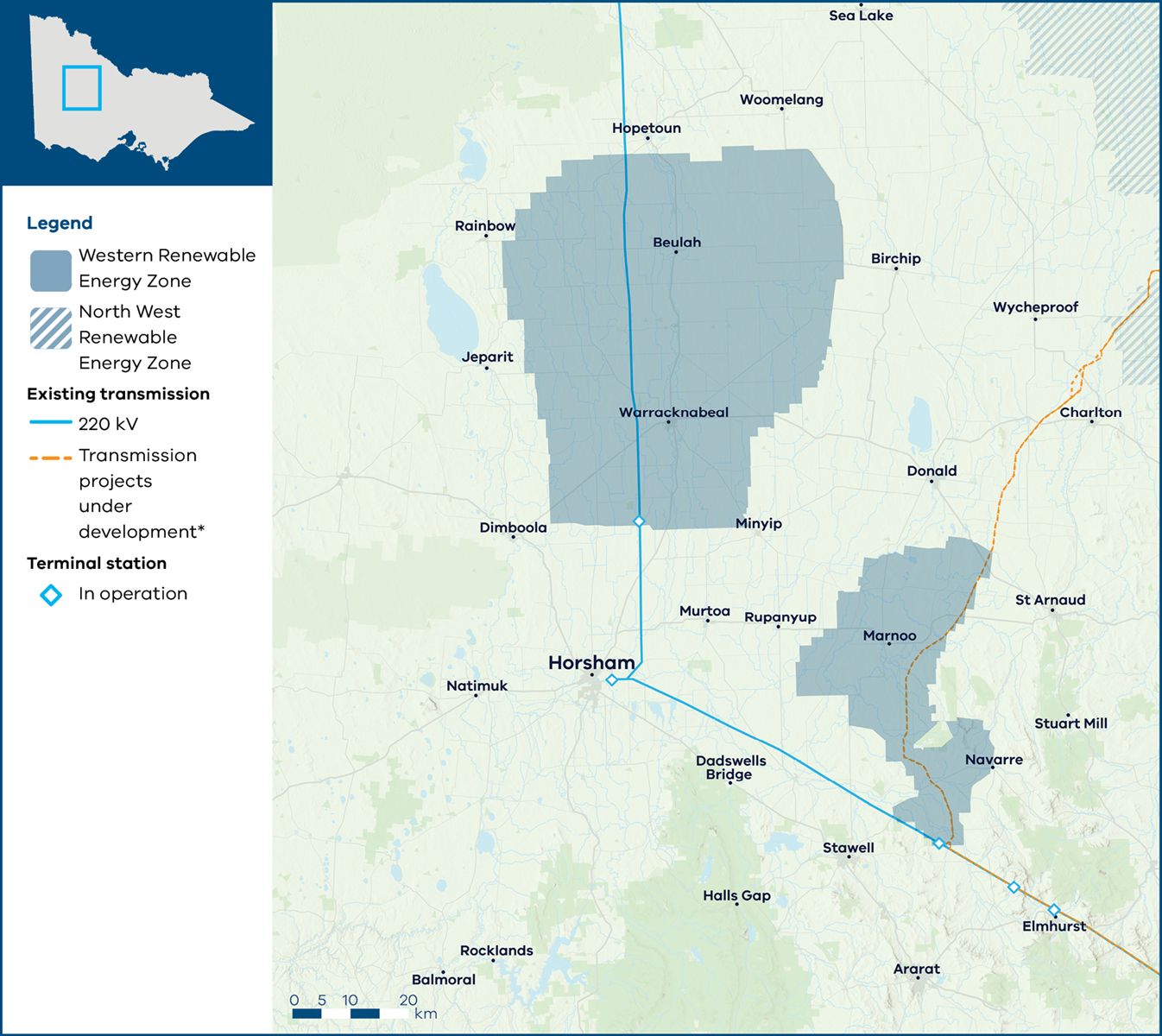
The 2025 Victorian Transmission Plan proposed a renewable energy zone with two sections in western Victoria. The eastern section is located between Stawell and Donald, and the western section is located north of Horsham, between Dooen and Hopetoun.
The Minister for Energy and Resources has formally declared the zone, with some adjustments made to the eastern section.
The declared Western Renewable Energy Zone includes parts of the Northern Grampians, Yarriambiack, Hindermarsh, and Buloke local government areas. There are two sections to the zone, an eastern and a western (see map below).
The zone is within the Registered Aboriginal Party boundaries of Barengi Gadjin Land Council and Dja Dja Wurrung Clans Aboriginal Corporation, and across areas of Country to the east that do not have a formally recognised Traditional Owner Group. Map of the Western Renewable Energy Zone.
View the REZ Orders and Statement of Reasons from the Minister for Energy and Resources at DEECA Energy.
To find out more, read the Western Renewable Energy Zone factsheet.
Map of the Western Renewable Energy Zone
Visit our online interactive map to see the renewable energy zones in more detail.
How did feedback shape the Western Renewable Energy Zone?
To shape the Western Renewable Energy Zone, we undertook engagement as part of the 2025 Victorian Transmission Plan development. This commenced in 2023 and was delivered across multiple consultation phases. Further engagement was then carried out as part of the renewable energy zone declaration process, between November 2025 and March 2026.
What we did in response to feedback:
- Combined what were initially two separate zones into one to provide more flexibility in where renewable energy projects, such as wind farms, can be developed
- Expanded the western section to provide greater opportunities for project developers and landholders to participate
- Avoided many sensitive landscapes and areas with important cultural, environmental and community values including Grampians (Gariwerd) National Park, Kara Kara National Park, Lake Buloke, the Wimmera River and natural conservation reserves around Stawell, Avoca and St Arnaud
- Committed to continuing to assess and seek feedback on important cultural, environmental and tourism values of these sensitive landscapes and areas
- Removed Joel Joel Nature Conservation Reserve, Morrl Morrl Nature Conservation Reserve and areas surrounding the Wimmera River
- Revised the zone to increase distance from culturally significant landscapes
You can read a summary report of engagement activities, timing and the outcomes in the What we heard – REZ consultation report below.
How will decisions about new renewable energy projects be made in the Western Renewable Energy Zone?
The Victorian Government is setting new rules to manage how renewable energy projects, such as wind and solar farms, gain access to the state’s transmission network.
Under the current open access regime, developers can connect their projects almost anywhere on the transmission network, as long as they meet technical and environmental planning requirements.
Under the new approach, known as the Victorian Access Regime, developers will apply for access and VicGrid will oversee a competitive process to decide which projects can connect within each zone.
Each zone will have a set limit on how much new renewable energy can be connected. We are proposing to set access limits that reflect how much electricity the network can carry at a given time, based on current infrastructure and planned upgrades.
In determining how much of the access limit is allocated, we will consider:
- the amount of electricity Victoria needs to generate to meet increasing demand
- the size of the zone and the density of projects
- whether developers are meeting expectations for landholder, community and Traditional Owner engagement and adding social value through initiatives and economic development.
This process will ensure Victoria produces enough energy to meet demand, while minimising the impact on communities, Traditional Owners, agriculture and the environment.
Find more information including frequently asked questions on our renewable energy zones page.
Page last updated: 05/10/26