
On this page:
What is a renewable energy zone?
Renewable energy zones are areas identified as the best places to host wind, solar and battery storage projects and are central to our transition away from coal to renewable energy.
Renewable energy zones will:
- help coordinate renewable energy projects and reduce the need for unnecessary transmission infrastructure
- enable VicGrid to set clearer rules around how projects gain access to the grid, including expectations for how developers engage with communities
- provide more certainty about how and where renewable energy projects are developed
- unlock new economic benefits for regional communities and Traditional Owners.
Where is the Gippsland Renewable Energy Zone?
The Gippsland Renewable Energy Zone is one of five declared zones in Victoria.
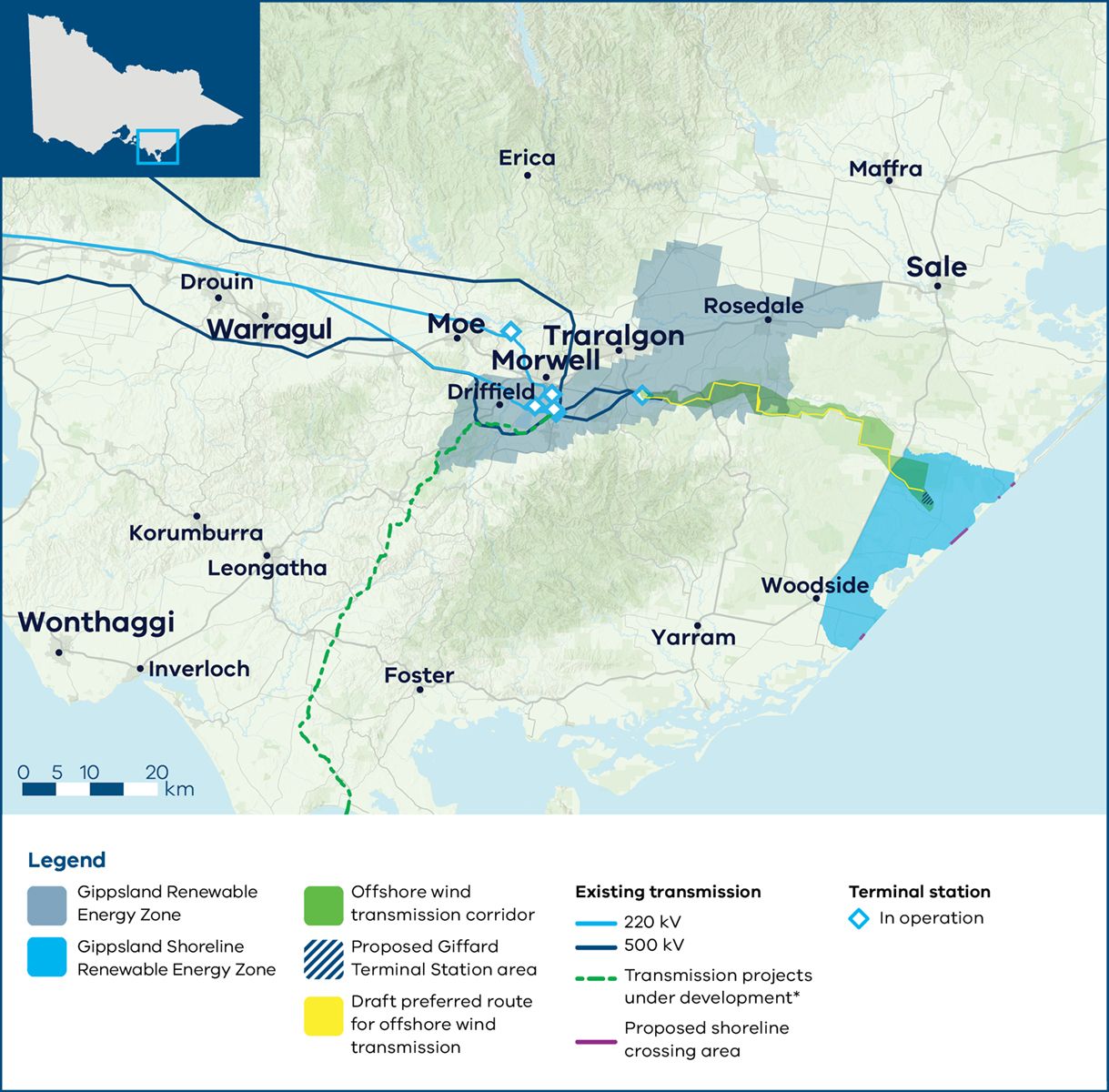
The declared Gippsland Renewable Energy Zone is located between Morwell and Sale and includes parts of the local government areas of Wellington Shire, Latrobe City and South Gippsland.
It sits within the Registered Aboriginal Party boundary of the Gunaikurnai Land and Waters Aboriginal Corporation.
When identifying this zone, we have aimed to balance complex land use issues across the region with the pressing need to position renewable energy zones with the best access to wind and solar energy.
We sought to coordinate access to existing transmission infrastructure to avoid the need to build more transmission lines for onshore renewable energy generation.
The Gippsland Shoreline Renewable Energy Zone has also been declared. The Gippsland Shoreline Renewable Energy Zone is different from the other renewable energy zones. It is a defined planning area where offshore wind developers will run underground cables from the shoreline to the electricity grid.
The map below shows the Gippsland Renewable Energy Zone, Gippsland Shoreline Renewable Energy Zone and the general area of new transmission lines and terminal stations proposed for Gippsland.
View the REZ Orders and Statement of Reasons from the Minister for Energy and Resources at DEECA Energy.
To learn more, read the Gippsland Renewable Energy Zone factsheet:
Map of the Gippsland Renewable Energy Zone
Visit our online interactive map to see the renewable energy zones in more detail.
How did feedback shape the Gippsland Renewable Energy Zone?
To shape the Gippsland Renewable Energy Zone, we undertook engagement as part of the 2025 Victorian Transmission Plan development.
This commenced in 2023 and was delivered across multiple consultation phases. Further engagement was then carried out as part of the renewable energy zone declaration process, between November 2025 and March 2026.
What we did in response to feedback:
- Avoided agricultural areas potentially less compatible with renewable energy infrastructure, particularly diary farms and the Macalister Irrigation District
- Avoided areas with higher dwelling densities in South Gippsland
- Avoided the habitat of the Giant Gippsland Earthworm
- Avoided significant landscapes along the Bass Coast, Wilsons Promontory, the Strzelecki Ranges, coastal reserves and wetlands
- Located the proposed renewable energy zone near the existing 500 kV transmission network around Loy Yang
- Included some plantation land where co-location with renewable energy infrastructure may be suitable
- Explored options to expand the proposed zone further east and south-east, but this was not progressed due to constraints with the RAAF base, and potential biodiversity and cultural heritage impacts
- Defined the boundaries using a standard approach to align them with existing administrative and planning features, such as roads and local government boundaries, which resulted in the removal of the small area overlapping with Baw Baw Shire
You can read a summary report of engagement activities, timing and the outcomes in the What we heard – REZ consultation report.
What will it be like living in a renewable energy zone?
If you live in or near a renewable energy zone, over time you will see more development of renewable energy generation and storage such as wind farms, solar farms and batteries. It is important to note that only a small proportion of land within the zone will be used for these projects.
VicGrid will work with developers to coordinate new development and associated transmission to minimise impacts on landscapes and the environment.
All proposed projects will continue to be subject to existing planning and environmental controls, including approval processes under the Planning and Environment Act 1987 and Environment Effects Act 1978.
How will decisions about new renewable energy projects be made in the Gippsland Renewable Energy Zone?
The Victorian Government is setting new rules to manage how renewable energy projects, such as wind and solar farms, gain access to the state’s transmission network.
Under the current open access regime, developers can connect their projects almost anywhere on the transmission network, as long as they meet technical and environmental planning requirements.
Under the new approach, known as the Victorian Access Regime, developers will apply for access and VicGrid will oversee a competitive process to decide which projects can connect within each zone.
Each zone will have a set limit on how much new renewable energy can be connected. We are proposing to set access limits that reflect how much electricity the network can carry at a given time, based on current infrastructure and planned upgrades.
In determining how much of the access limit is allocated, we will consider:
- the amount of electricity Victoria needs to generate to meet increasing demand
- the size of the zone and the density of projects
- whether developers are meeting expectations for landholder, community and Traditional Owner engagement and adding social value through initiatives and economic development.
This process will ensure Victoria produces enough energy to meet demand, while minimising the impact on communities, Traditional Owners, agriculture and the environment.
Find more information including frequently asked questions on our renewable energy zones page.
Page last updated: 20/10/26