
On this page:
What is a renewable energy zone?
Renewable energy zones (REZs) are areas identified as the best places to host wind, solar and battery projects, and will play a key role as Australia transitions the energy grid from coal to renewable energy.
Renewable energy zones will:
- help coordinate renewable energy projects and reduce the need for unnecessary transmission infrastructure
- enable VicGrid to set clearer rules around how projects gain access to the grid, including expectations for how developers engage with communities
- provide more certainty about how and where renewable energy projects are developed
- unlock new economic benefits for regional communities and Traditional Owners.
Renewable energy zones give communities and industry more clarity about where renewable energy projects are most suitable. Other states in Australia with active or planned renewable energy zones include New South Wales, Queensland, South Australia and Tasmania.
Where are Victoria's renewable energy zones?
The 2025 Victorian Transmission Plan proposed six renewable energy zones and a shoreline zone to connect offshore wind projects in Gippsland. The Victorian Government has now declared five of these zones, along with a shoreline zone, with some changes to proposed boundaries.
See the renewable energy zones in more detail on our online interactive map, which includes a search function and the option to download shape (GIS) files.
Learn more about each of Victoria's renewable energy zones below:
- South West Renewable Energy Zone
- Central Highlands Renewable Energy Zone
- Western Renewable Energy Zone
- North West Renewable Energy Zone
- Gippsland Renewable Energy Zone
- Gippsland Shoreline Renewable Energy Zone
The Gippsland Shoreline Renewable Energy Zone is different from other renewable energy zones. It is a defined planning area where offshore wind developers will run underground cables from the shoreline to the electricity grid.
The 2025 Victorian Transmission Plan also included a proposed Central North Renewable Energy Zone. This zone will no longer go ahead as a result of further technical assessments and community consultation.
View the REZ Orders and Statement of Reasons from the Minister for Energy and Resources at DEECA Energy.
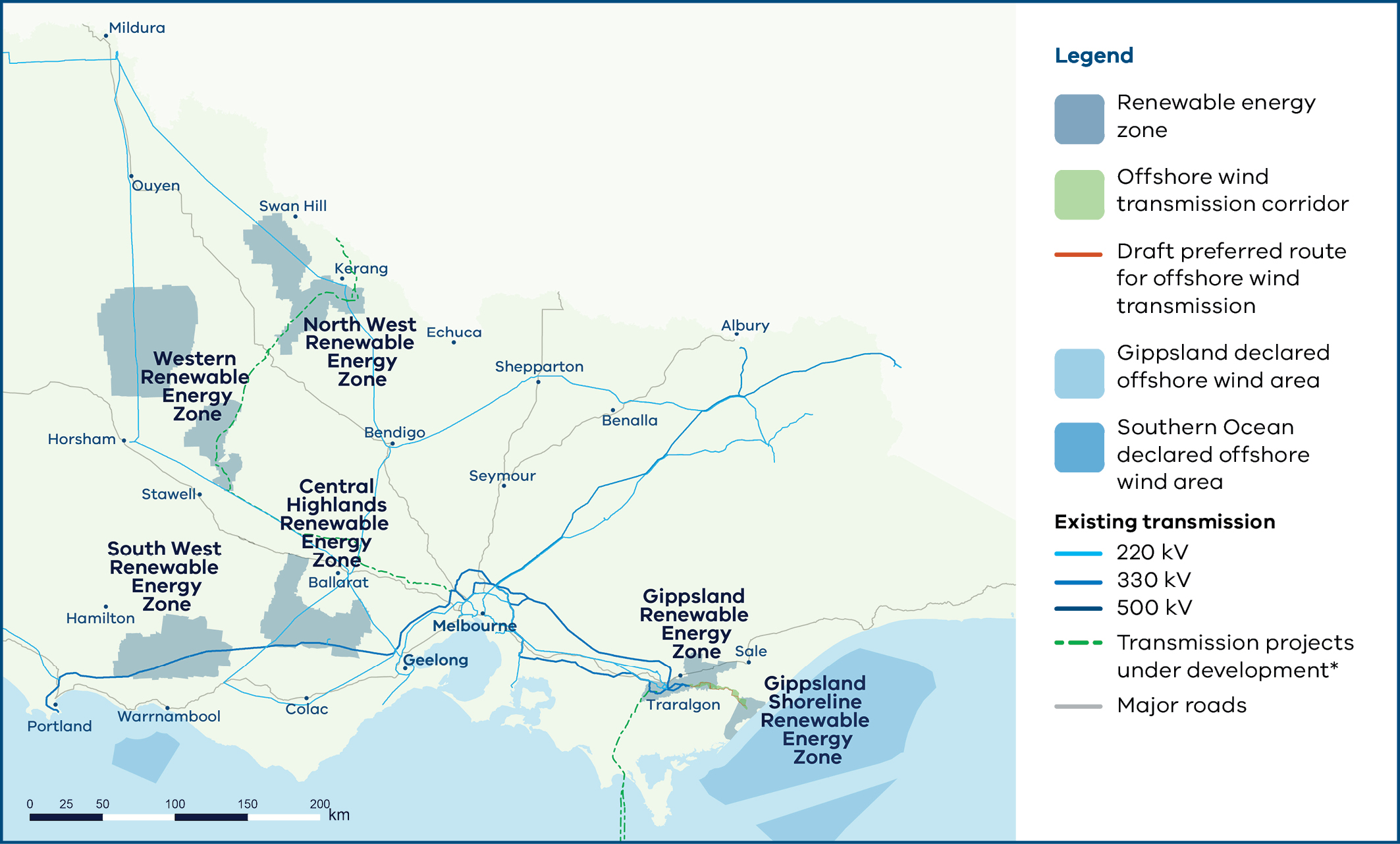
Map of the zones
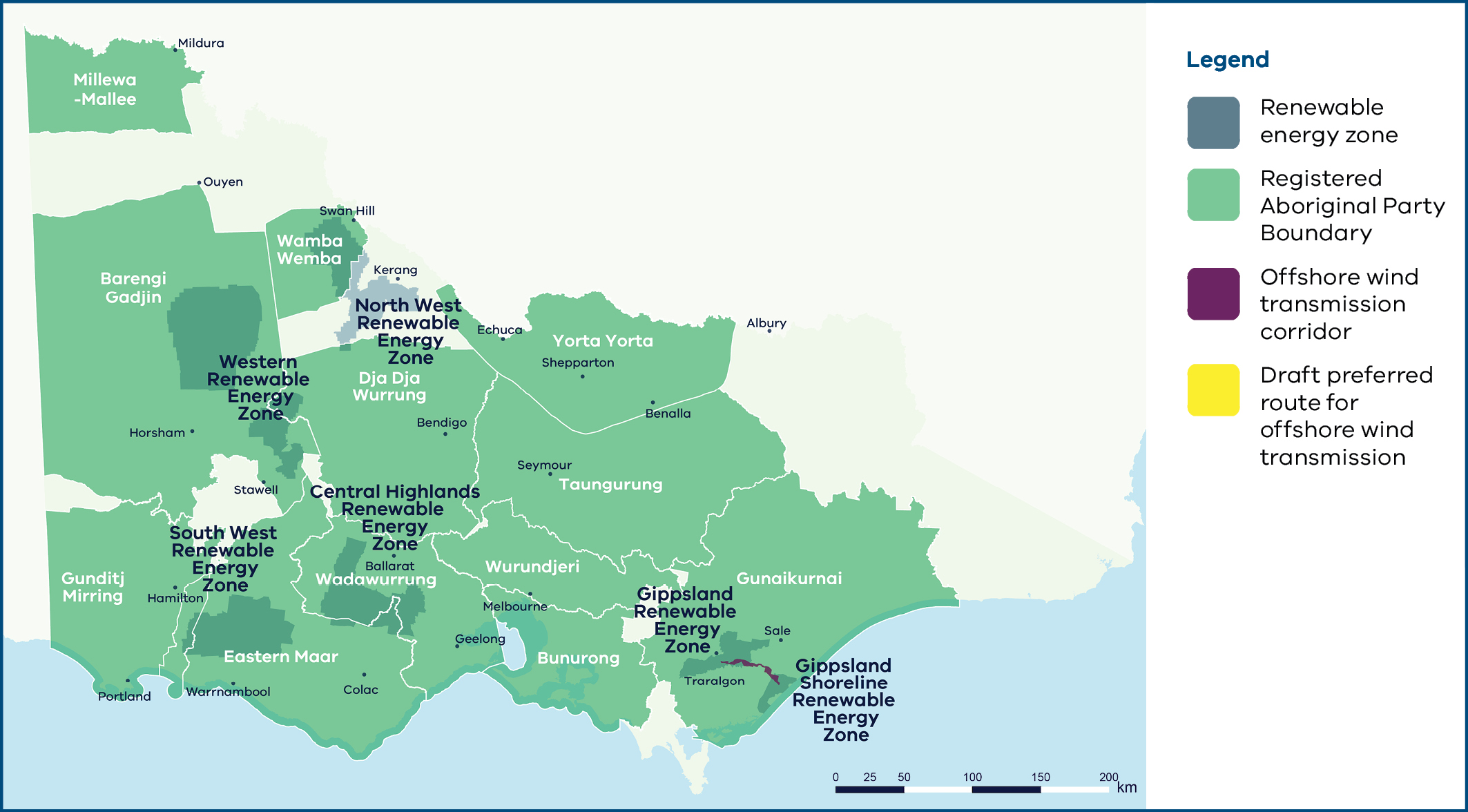
Map with Registered Aboriginal Party boundaries
What will it be like living in a renewable energy zone?
If you live in or near a renewable energy zone, over time you will see the construction of wind, solar and large-scale battery projects, many of which are already in development. It is important to note that only a small proportion of land within the zone will be used for these projects.
VicGrid will work with developers to coordinate projects and any transmission lines required to support zones to minimise impacts on landscapes, communities, Traditional Owners and the environment.
All proposed projects will continue to be subject to existing planning and environmental controls, including approval processes under the Planning and Environment Act 1987 and Environment Effects Act 1978.
Renewable energy project developers must talk to landholders to get permission to build renewable generation projects on their land. Landholders can choose whether or not to host a wind, solar or battery project.
Landholders who choose to host projects will receive financial payments and other benefits negotiated directly with the developer.
Project developers will also work with neighbouring properties to address impacts and negotiate financial benefits.
Communities in zones will also see new social value and economic benefits as part of the Renewable Energy Zone Community Benefits Plan.
How were renewable energy zones were selected?
Identifying areas for Victoria’s renewable energy zones involved carefully balancing many factors, including:
- access to the state’s strong winds and sunshine to produce renewable energy
- access to existing or planned transmission infrastructure
- if farming in the area can co-exist with renewable projects
- impacts on the environment and biodiversity
- impacts on local communities
- impacts on Traditional Owners and culturally sensitive areas
- interest from renewable energy project developers.
We also invited feedback alongside the development of the renewable energy zones, and the 2025 Victorian Transmission Plan, whereby more than 10,000 feedback response were received from submissions, survey responses, conversations and more.
We carefully considered all feedback, but not all community or industry requests have been acted on. The 2025 Victorian Transmission Plan and the renewable energy zone declarations reflect difficult choices, made by weighing up many factors to deliver a plan that best serves all Victorians.
These decisions balance energy needs, land use, environmental impacts and community concerns.
Find more information on the planning process, including a report on what we heard through our engagement activities below.
What happens next?
Declaring renewable energy zones is not the end of the process. Over the next 12 to 24 months, VicGrid will do the following:
- Finalise the rules that renewable energy and storage projects must follow to develop within a zone, including the requirement to meet the expectations that will be outlined in the Community Engagement and Social Values Guidelines.
- Set limits on how much new renewable energy generation can connect to the network within each zone.
- Work with existing projects seeking connection to the network to meet community expectations.
- Monitor the performance of projects that gain access and review if they are meeting the conditions of their connection agreement.
- Support the creation of community energy funds and work with communities on how those funds are spent.
- Continue planning the necessary transmission projects, and work with generation and storage projects to coordinate their infrastructure and minimise environmental and community impacts.
Throughout all these steps, we will continue to engage with communities, landholders, Traditional Owners, industry and local government.
The feedback captured to date will continue to help shape these processes as Victoria progresses towards a coordinated and fair energy transition.
You can learn more about the new rules and guidelines that will enable this work on the Victorian Access Regime page.
Frequently asked questions
Each order sets out:
- a map of the zone with defined boundaries
- transmission projects to enable the zone
- the intended hosting capacity – that is, how much generation the planned transmission network could support in the zone.
The orders make it a requirement that solar, wind and battery project developers meet government expectations for community engagement and deliver social value and economic benefits.
The Gippsland Shoreline Renewable Energy Zone order also includes information about shoreline crossing areas – the locations where the cables to connect offshore wind energy to the grid may cross the shoreline. You can view the orders on DEECA's website.
The zones mapped in the draft orders did not have defined boundaries. In the final orders, boundaries have been defined.
The process for defining the boundaries considered feedback and used a standard approach to align them with existing administrative and planning features – such as roads and local government boundaries.
The declared renewable energy zones are:
- South West REZ Located south-west of Hamilton, between Macarthur and Darlington
- Western REZ: Includes two sections, one between Stawell and Donald, and the other north of Horsham between Dooen and Hopetoun
- North West REZ: Located between Kerang and Swan Hill.
- Central Highlands REZ: Located to the west and south of Ballarat.
- Gippsland REZ: Located between Morwell and Sale.
- Gippsland Shoreline REZ: Located near Woodside, Giffard and Seaspray.
You can see the renewable energy zones in more detail on our online interactive map, which also includes a search function, allowing you to search for property addresses.
Users also have the ability to select options that demonstrate how zones have changed over the course of the process to develop them through previous consultations.
No. The introduction of renewable energy zones does not alter existing land use zones and overlays.
There are several land use zones in Victoria where the development of wind, solar and battery projects is possible, provided a planning permit is obtained, such as the Farming Zone and Rural Activity Zone.
Equally, there are land use zones and overlays that prohibit development, such as the Urban Growth Zone and any land reserved under the National Parks Act 1975.
The establishment of renewable energy zones does not replace the need for transmission or generation projects to obtain the relevant planning and environmental approvals.
Identifying areas for Victoria’s renewable energy zones involved carefully balancing many factors, including:
- access to the state’s strong winds and sunshine to produce renewable energy
- access to existing or planned transmission infrastructure
- if farming in the area can co-exist with renewable projects
- impacts on the environment and biodiversity
- impacts on local communities
- impacts on Traditional Owners and culturally sensitive areas
- interest from renewable energy project developers.
The location of zones was also influenced by more than 10,000 pieces of feedback received from community members, landholders, Traditional Owners, Councils, community groups, agricultural bodies and energy industry stakeholders.
We carefully considered all feedback, but not all community or industry requests have been acted on. The 2025 Victorian Transmission Plan and the renewable energy zone declarations reflect difficult choices, made by weighing up many factors to deliver a plan that best serves all Victorians.
These decisions balance energy needs, land use, environmental impacts and community concerns.
All feedback on the draft renewable energy zone orders was recorded, reviewed and analysed using a consistent approach to ensure transparency and fairness.
Submissions were grouped into common themes, allowing similar issues to be considered consistently across regions while still taking local context into account where relevant.
Each submission was then assessed against a set of criteria, including whether the feedback:
- identified significant new information not previously considered
- suggested changes that could reduce impacts on Traditional Owners, the environment, land use or local communities
- affected the efficient use of existing or planned transmission infrastructure
- supported or conflicted with system planning objectives set out in the 2025 Victorian Transmission Plan, that is, ensuring reliable, safe and secure electricity supply, while keeping costs as low as possible for consumers.
You can view all public submissions at Engage Victoria. A Statement of Reasons has also been prepared for each declared zone, which summarises the feedback received and how it was considered.
Hosting capacity is the total space that will be available on the grid – for existing generation, committed projects, and new projects within the zone – once planned transmission upgrades are built.
Now that the zones are declared, we will set access limits for each zone to determine how much space on the transmission network is available for new renewable energy projects. We are proposing to set access limits to reflect the hosting capacities.
Once the Victorian Access Regime comes into effect, VicGrid will oversee a competitive process to decide which projects can connect within each zone.
In determining how much is allocated, we will consider:
- the amount of electricity Victoria needs to generate to meet increasing demand
- the size of the zone and the density of projects
- whether developers are meeting expectations for landholder, community and Traditional Owner engagement and adding social value through initiatives and economic development.
This process will ensure we ultimately produce enough energy to meet demand while also considering the impact on communities, Traditional Owners, agriculture and the environment.
This allocation process will provide a clearer picture to community about the number and size of projects inside renewable energy zones.
VicGrid recognises the crucial contribution the agriculture sector makes to Victoria’s economy, regional communities, food security and way of life.
We’re committed to engaging closely with landholders and agriculture industry groups to make sure they have a voice in the planning of energy infrastructure.
We’ve really been listening to farmers as we’ve developed renewable energy zones to understand the potential impacts of development on farming operations.
We’ve engaged with regional, state and national groups representing farmers from the livestock grazing, dairy, cropping, horticulture, nursery and garden and forestry sectors.
We met with peak bodies and landholder groups and received submissions from individuals and organisations.
We considered statewide datasets related to agricultural land use in our statewide strategic land use assessment, looking at data on farmgate output, soil quality, rainfall, irrigation and farm infrastructure investment.
The sector told us that we needed to do detailed work to understand the potential impacts of different kinds of energy development on different types of farming in different regions.
So we carried out a program of research and engagement with agriculture stakeholders across the state to understand the compatibility of different types of farming with renewable energy development.
Our engagement with the agriculture industry has played a key role in our decision-making about the location of renewable energy zones.
Every farm is different but, in general, we have heard from farmers the more complex and intensive the farming is, the more challenging it is to host renewable energy infrastructure on a farm.
We were told that dairy, intensive animals, nurseries and aquaculture were often the least compatible with renewable infrastructure.
Livestock grazing and dryland broadacre cropping were identified as more compatible.
In all cases, we heard the very strong message that biosecurity and farm access need to be carefully managed.
We have taken all of this on board in our planning and sought to avoid areas where farming practices are said to be less compatible with energy development.
Decommissioning of solar and wind farms in Victoria is primarily governed through planning permit conditions, Victorian Planning Provisions, and contractual/lease obligations between developers and landholders.
In Victoria, all utility-scale projects (greater than one megawatt) require a planning permit issued by the Minister for Planning under the Planning and Environment Act.
Decommissioning is a mandatory planning permit condition under the Environmental Management Plan.
The Environmental Management Plan must describe measures to minimise any amenity and environmental impacts of the construction and decommissioning of the facility.
Within 3 months of the facility permanently ceasing operation, a Decommissioning Management Plan (DMP) prepared by a suitably qualified and experienced person must be submitted to, approved and endorsed by the responsible authority.
Requirements exists that all decommissioning works identified in the DMP be completed to the satisfaction of the responsible authority as soon as practicable, but no later than 12 months after the DMP is endorsed, or such other period approved by the responsible authority.
In addition, VicGrid is proposing to set new expectations with regard to decommissioning for new projects as a condition of gaining access to the grid.
This would require developers to specify their responsibilities and commitments on decommissioning, remediation and any other end-of-life arrangements through host landholder agreements.
This would include negotiation of landholder protections and financial safeguards.
It is the choice of landholders whether or not they host wind, solar or battery projects.
VicGrid is aware of no instances where easements for wind and solar farms or batteries have been compulsorily acquired in Victoria, nor any instances where easements for private lines to connect generation projects to the transmission network have been compulsorily acquired in Victoria.
Fire agencies have well established operational procedures in place to respond to emergencies at renewable energy facilities including solar, wind and battery projects.
The Country Fire Authority is continually refining and reviewing these procedures and works at a local level to ensure brigades and volunteers are familiar with any renewable energy development and given the training they need.
Page last updated: 30/09/26