
On this page:
About the project
Offshore wind will play a major role in Victoria’s energy transition – and Gippsland has some of the best wind resources in the world.
VicGrid is developing shared transmission infrastructure to connect the first 2 gigawatts (GW) of offshore wind energy to the grid. The line will use 500 kilovolt (kV) double-circuit overhead transmission line technology, starting near a proposed new terminal station in Giffard and connecting to the Loy Yang Power Station switchyard.
The project will support Gippsland's offshore wind energy development and help deliver safe, reliable and affordable power for Victoria’s future.
VicGrid acknowledges the Gunaikurnai people as the Traditional Owners of the lands on which this project is being developed, and pays respect to their Elders past and present.
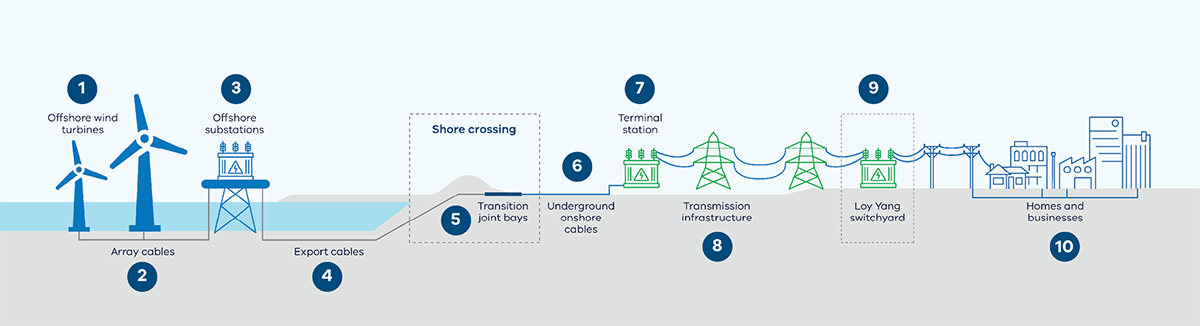
Part of our role is to coordinate how offshore wind energy projects connect to the grid to minimise impacts on communities, Traditional Owners and the environment. Learn more on our Gippsland Shoreline Renewable Energy Zone page.
Preferred route and reference design
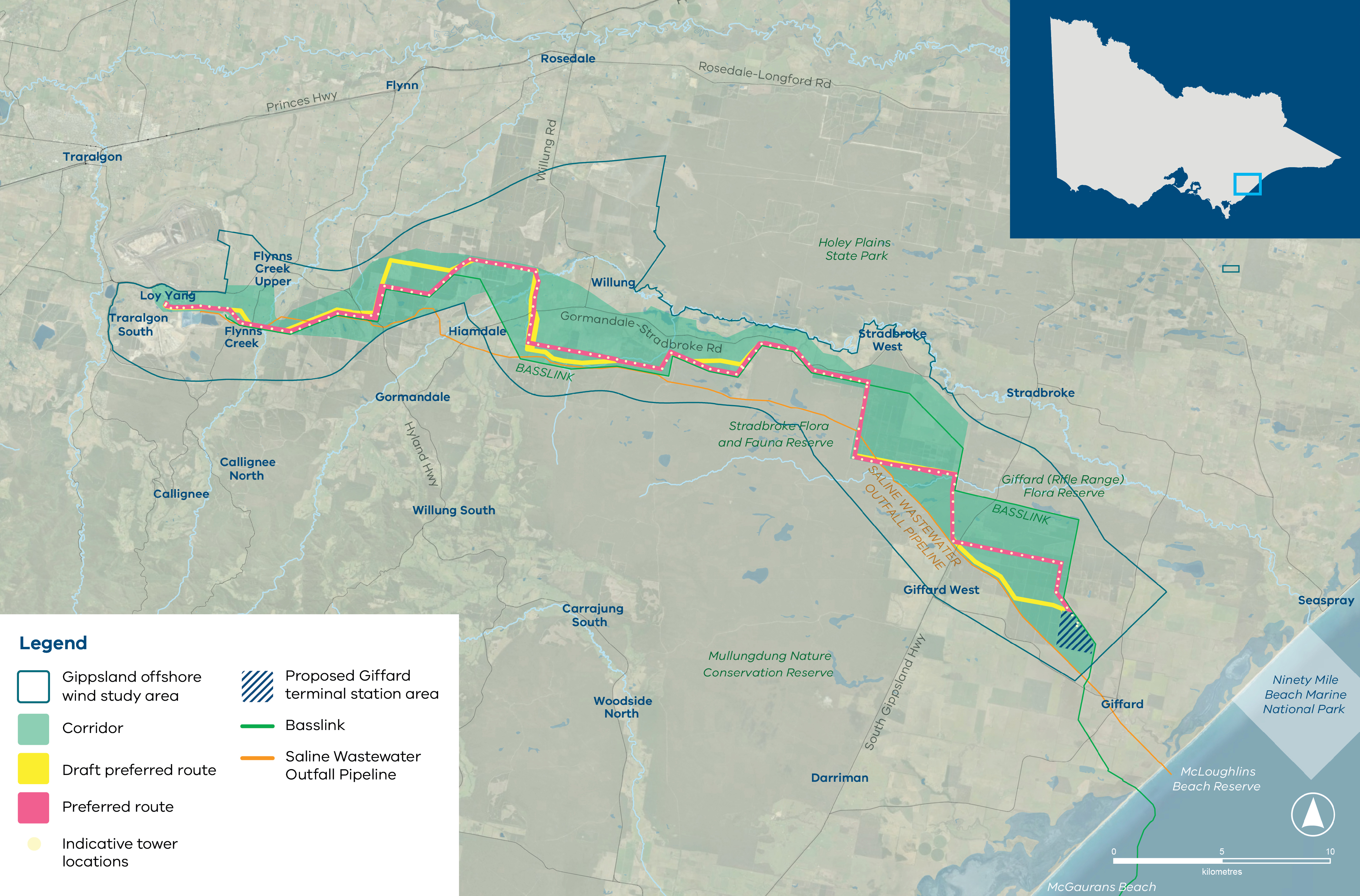
We’ve identified a preferred route for the transmission line – a defined area about 60 km long and 200 m wide that will include a final easement.
We’ve also developed a reference design for assessment in the project’s Environment Effects Statement (EES).
The preferred route and indicative easement describe where the transmission line could go.
The reference design describes what's involved in building it.
This early design shows one way the project could be built, including:
- Indicative transmission tower locations
- Indicative easement
- Likely construction activities
The reference design provides the detail needed to assess likely construction and operation impacts and how they can be avoided, reduced or managed. Learn more about the preferred route and reference design in the factsheet below.
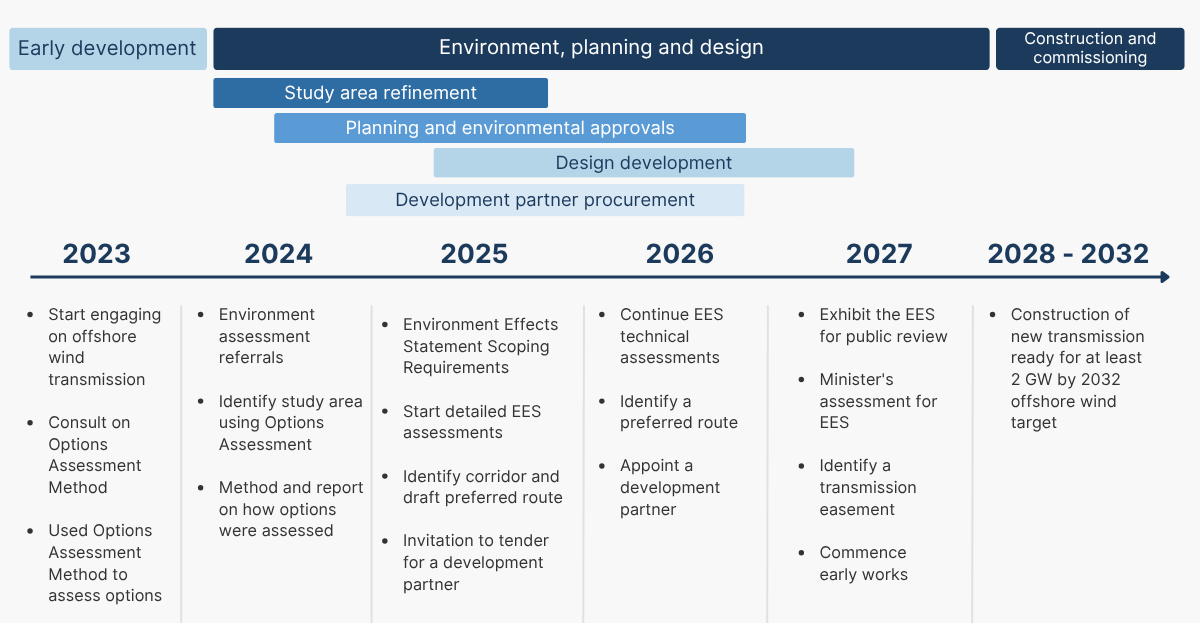
The community will have a formal opportunity to view the reference design and make a written submission when the EES is publicly exhibited in early 2027.
The final detailed design for the project will be developed after the EES is complete, taking into account the Victorian Minister for Planning’s assessment.
Have your say and learn more
If you'd like to speak with the project team, we're here to help:
- Landholders can call 1800 959 431 or email us at landholders@vicgrid.com.au
- Community members can call 1800 418 341 (9am–5pm, Monday to Friday) or email enquiries@vicgrid.com.au
- Join a community information session in September and October 2026. Find details on our Events and webinars page.
- Share your feedback online via our interactive map. View the preferred route and indicative easement and tell us about the places, land uses and land values that matter to you.
How we got here
We identified the transmission line’s preferred route in stages, starting with a broad study area and progressively narrowing it to a corridor, a draft preferred route, and a preferred route and indicative easement.
-
April 2023 - Development and engagement roadmap
Published the Offshore wind transmission development and engagement roadmap, outlining a plan for new offshore wind transmission infrastructure.
-
Mid-2023 - Options assessment method
Community feedback helped refine the options assessment method – the decision-making tool used to inform our selection of the study area.
-
March 2024 - Study area identified
Shared the study and connection hub areas, which avoided major townships and included a lower proportion of agricultural land to minimise impacts on smaller private landholders and farmers.
-
December 2024 - Study area refined
Further refined the study area and ruled out certain locations, including Holey Plains State Park and areas near the Loy Yang Power Station.
-
October 2025 - Corridor & draft preferred route identified
Refined the study area to a corridor and draft preferred route, reducing the number of affected private properties from 267 to 24. In response to feedback, we co-located with existing infrastructure where possible, prioritised public and plantation land, avoided native vegetation and sensitive habitats, and limited impacts on homes and agricultural operations.
-
September 2026 - Preferred route identified
Identified a preferred route and indicative easement. The number of affected private properties was further reduced from 24 to 20. In response to feedback, we moved the line closer to the existing Basslink electricity interconnector in several areas and worked with plantation owners to minimise impacts wherever possible.
Environment Effects Statement
We’re preparing an Environment Effects Statement (EES) to assess the project’s potential environmental, social, cultural and economic impacts. Before construction can begin, the project must complete the EES process and receive the required Commonwealth and Victorian Government approvals. Learn more at Planning and environment.
Field surveys
Since 2024, we’ve carried out field surveys and technical studies across the project area to better understand:
- Existing buildings and land features
- Environmental conditions
- How land is used for farming and other activities
We're using the information from these surveys to prepare the EES and help determine the transmission line's most suitable location.
Learn more about field survey land access at Working with landholders and the community.
Development partner
VicGrid is running a competitive two-stage tender process to select a development partner to design, build, finance, operate and maintain the transmission line and connection hub.
Together with the development partner, we’ll work closely with landholders, Traditional Owners and local communities to continue developing the project in a manner that delivers value for Victorian energy users.
We expect to appoint a development partner in late 2026.
Learn more
Watch our webinars on Engage Victoria for project updates, to catch up on past community information sessions and to learn about the Environment Effects Statement (EES).
Read an independent technical report about alternate technology for the transmission line below.
Page last updated: 22/09/26